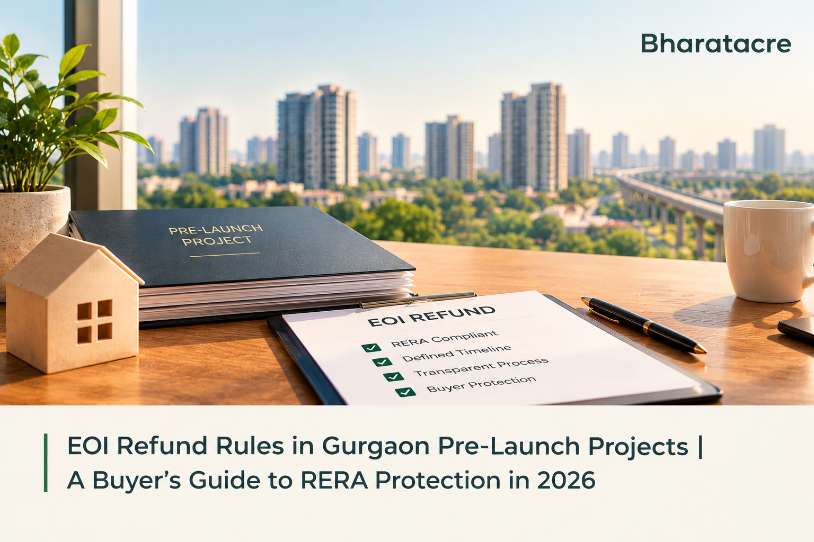









BHARATACRE | BUYER GUIDE
A practical checklist for buyers evaluating new-launch inventory or a luxury resale apartment.
Introduction
Buying a luxury property in Gurgaon can begin with a site visit, a conversation with a sales representative or an invitation to submit an Expression of Interest (EOI). Sometimes, the next step is paying a token amount to secure a preferred apartment, floor, or other purchase opportunity.
At this stage, buyers may be focused on the price, location, views, amenities and potential appreciation. However, some of the most important decisions involve easy-to-overlook documents.
What happens if you do not receive the unit you selected? Is your EOI refundable? Does the quoted price include all applicable charges? Is the payment going to the correct entity? Does the written offer match what the sales representative promised?
For a luxury property worth several crores, even a small misunderstanding can create a costly dispute or delay.
This guide explains 15 things to verify in writing before paying an EOI, booking amount or token for a luxury property in Gurgaon. It covers both new developer inventory and resale apartments, while highlighting where the checks differ.
The objective is simple: make an informed decision before money changes hands.
First, understand what you are paying for
An EOI, token amount and booking amount are not interchangeable in every transaction. Their practical and legal effect depends on the document, the parties, the terms and the applicable law.
Expression of Interest (EOI): Usually records your interest in a property or an offer. It may or may not secure a specific unit, depending on its terms.
Token amount: Commonly used to demonstrate an intention to proceed with a particular transaction. The payment's purpose and refund conditions should be documented.
Booking amount: May initiate a formal allotment or purchase process. The booking documents should identify what happens next and which terms govern the transaction.
Never judge your rights solely by the label used by a sales representative.
Also identify whether you are dealing directly with a developer or buying from an existing owner. The documents and legal checks for primary inventory and resale property can differ significantly.
15 things to verify before paying an EOI or token
1. Verify the project's HRERA registration
For a luxury residential project in Gurgaon, start by checking the project's registration details on the official Haryana Real Estate Regulatory Authority, Gurugram website.
Verify the registered project name, registration number, promoter details and relevant registration status. Review available project documents, registered updates and relevant public notices or orders.
Do not rely only on a brochure, advertisement, social media post or screenshot shared by a salesperson.
Ask for this in writing: The official project registration number and the registered name of the promoter.
Red flag: You are asked to pay urgently, but the person handling your enquiry cannot provide the basic registration details or explain the project's registration status.
Registration is an important check, but it does not automatically establish that every claim about a particular unit is correct.
2. Confirm that the exact phase and tower are covered
Large residential developments may have multiple phases, towers, configurations or approvals. A project's marketing name alone may not tell you which registered phase contains the apartment being offered.
Check whether the tower, phase and relevant unit details match the documents provided to you.
This is particularly important when sales representatives discuss an upcoming phase, a newly announced inventory release or a property that is described as available before a formal launch event.
Ask for this in writing:
Registered phase and tower details.
Relevant project registration number.
Confirmation of the unit's inclusion in that phase.
Any applicable registration extension or revised schedule.
Do not assume that documents covering one phase automatically cover every part of a larger development.
3. Request the sanctioned plans and relevant approvals
Before making a payment, ask what approvals and sanctioned plans apply to the property.
Review the relevant building plan, layout plan, apartment specifications and other project documents available from the promoter or official records. If a particular tower or component is still awaiting approval, ask for a clear written explanation.
Marketing images and sample apartments are not substitutes for approved plans.
A premium apartment may look attractive in a brochure, but buyers should understand what is actually approved and what is being offered for sale.
Ask for this in writing: The applicable sanctioned plans and a clear explanation of any pending approvals relevant to your unit.
Have an independent property lawyer review material gaps before you commit.
4. Get the exact unit details confirmed
A buyer may express interest in a particular floor, view, tower or apartment configuration. However, interest in a unit does not necessarily mean the unit has been formally allotted.
Before paying, establish exactly what the amount is intended to secure.
Your written document should identify, where applicable:
Project, phase and tower.
Apartment or unit number.
Floor and configuration.
Area and relevant layout.
Whether the unit is provisional or finally allotted.
Conditions governing substitution or non-availability.
Ask the sales representative: If this exact unit cannot be allotted, what happens to my payment?
Get the answer in the EOI or booking document rather than relying on a verbal promise.
For high-value properties, the distinction between a preferred unit and an officially allotted unit matters.
5. Verify the carpet area, layout and promised specifications
Two apartments with similar advertised prices can offer very different practical value.
Review the RERA carpet area and the relevant floor plan. Understand the separate treatment of balconies, exclusive-use spaces and other areas. Do not compare apartments using different area definitions without accounting for the difference.
Next, verify the specifications promised with your unit. These could include flooring, fittings, appliances, ceiling heights, wardrobes, smart-home features or other features specifically included in the offer.
Ask for this in writing:
Applicable carpet area and floor plan.
Specifications and finishing schedule.
Any additional spaces or features included.
Whether advertised furnishings or upgrades are standard or optional.
If a feature influenced your buying decision, obtain confirmation that it forms part of the documented offer.
6. Understand the actual purpose of the EOI
Before making an EOI payment, understand what it does and does not secure.
Does it merely register your interest? Does it provide a preference for a particular configuration? Is it connected to a draw, inventory allocation, launch offer or another process? Does the developer have the right to change the price or available units before allotment?
These terms can materially affect your decision.
Ask for the full EOI form and any terms referenced in it. Read the conditions before transferring funds, including provisions describing the next stage of the purchase.
Ask for written confirmation of:
1. The purpose of the EOI.
2. Whether a particular unit is reserved.
3. How allotment will be determined.
4. When the offer expires.
5. What happens if allotment does not occur.
Do not assume that an EOI guarantees a unit, a fixed price or an assured return.
7. Get the EOI refund and cancellation policy in writing
This is one of the most important checks before paying a property token in Gurgaon.
A statement such as "the amount is refundable" is incomplete unless the applicable conditions are clear.
Ask what happens if you withdraw, the unit becomes unavailable, allotment is unsuccessful, the offer changes or the developer does not proceed as described.
Your document should clarify:
The circumstances in which a refund is available.
Any applicable deductions.
The refund deadline or processing period.
The method and recipient of the refund.
The conditions under which cancellation may affect your entitlement.
Also verify whether the refund depends on a specific deadline or other action you must complete.
Red flag: The salesperson promises a full refund verbally, but the written document allows deductions or does not explain the refund process.
Never assume that every EOI is automatically refundable merely because it is called an expression of interest. The actual terms and applicable law matter.
8. Obtain the complete cost sheet, not just the basic sale price
A headline price is not the total amount required to purchase and own a luxury apartment.
Ask for an itemised cost sheet that identifies the basic sale price, applicable floor or location premiums, parking-related charges where applicable, club or facility charges, maintenance-related deposits, infrastructure charges, taxes and other amounts relevant to the transaction.
For a resale property, request the seller's asking price separately from any transfer charges, outstanding instalments or other costs that may apply.
Also identify applicable stamp duty, registration fees and taxes. The actual amounts depend on the transaction and the relevant rules.
Ask for this in writing: The complete estimated acquisition cost, payment milestones, applicable taxes, charge descriptions and any exclusions.
A reliable buyer comparison should distinguish confirmed charges from estimates or amounts that may change.
9. Review the payment schedule and default conditions
A payment plan can affect your finances as much as the initial purchase price.
Check whether the property follows a construction-linked, time-linked or other payment plan. Understand what triggers each instalment and whether you must pay after a particular construction milestone, on a fixed date or after receiving a formal demand.
Review the consequences of delayed payments by the buyer and the consequences of delayed possession by the promoter, as applicable.
Ask for this in writing:
Complete payment schedule.
Conditions triggering each instalment.
Interest or other consequences for late payment.
Procedure for raising a payment dispute.
Method for issuing formal payment demands and receipts.
If a sales representative describes a payment plan that differs from the supplied documents, ask for corrected documentation before transferring funds.
10. Understand the 10% rule and the agreement for sale
Section 13 of the Real Estate (Regulation and Development) Act, 2016 addresses advances and application fees accepted by a promoter.
For a covered transaction, a promoter cannot accept more than 10% of the cost of an apartment, plot or building as advance payment or application fee without first entering into a written agreement for sale and registering that agreement.
This is an important protection for buyers, but it should be understood accurately. It does not mean that every EOI or token is automatically refundable, nor should the rule be treated as a universal answer to every resale transaction or payment arrangement.
Before making a substantial payment, establish which entity is receiving it, what document governs the payment and how the transaction is structured.
Ask for this in writing:
The draft agreement for sale.
The proposed date for signing and registration.
The payment schedule.
The possession date and relevant obligations.
The treatment of any earlier EOI or booking amount.
If you are asked to cross the statutory threshold without the required agreement, pause the transaction and seek independent legal advice.
11. Confirm who is authorised to receive your money
A legitimate-looking booking form does not, by itself, establish that the payment instructions are genuine.
Before transferring money, verify the identity of the entity receiving it and its authority to collect the amount.
If you are dealing through a broker or channel partner, confirm the person's role and registration status where applicable. Independently verify the payment instructions through contact details obtained from the official developer website or another reliable source.
Avoid paying into a personal account or an unrelated entity's account merely because you received a message asking you to do so.
Your written record should identify:
The payer.
The recipient's legal name.
The amount and payment purpose.
The relevant property and transaction.
The account details verified through an independent channel.
The receipt and refund process.
Retain the payment confirmation and official receipt.
12. Put every important sales promise in writing
During a luxury property sale, a buyer may hear promises about discounts, special views, preferred floors, parking, interiors, furnishings or other benefits.
Some offers may be genuine, but buyers should not rely on a verbal promise that isn't in the applicable documentation.
Ask for the complete written terms of every incentive that influences your decision.
For example, if a discount is conditional on payment before a particular date, the relevant deadline and conditions should be explicit. If a feature is included only in selected apartments, the document should identify whether your unit qualifies.
Be particularly careful with claims of guaranteed rental income, fixed appreciation or assured resale value. Do not accept such claims without examining the underlying contractual terms, supporting evidence, and applicable legal requirements.
Rule to follow: If an assurance is important enough to influence a purchase worth several crores, it is important enough to document.
13. Verify the possession date and the consequences of delay
For under-construction luxury property in Gurgaon, confirm the possession date shown in the relevant registered project documents and the applicable agreement.
Distinguish an official commitment from a sales estimate such as "expected soon" or "possession within three years."
Read the clauses relating to extensions, delay, compensation, refund rights and other remedies. Their application depends on the circumstances, contractual terms, and applicable law.
For ready-to-move properties, verify the occupancy certificate applicable to the relevant tower or phase and examine the actual handover status.
Ask for this in writing:
Contractual possession date.
Relevant registered completion or possession schedule.
Applicable extension and delay provisions.
Conditions for possession and handover.
Do not make a purchase decision based solely on an estimated possession date communicated in a call or message.
14. For resale properties, verify ownership, dues, and transfer requirements
Buying a luxury resale apartment requires additional checks because the seller may have contractual obligations, outstanding payments, or restrictions on transferring the property.
Ask for documents establishing the seller's ownership or rights to transfer, such as the relevant allotment documents, agreement for sale or registered conveyance deed, depending on the transaction stage.
Check the payment history, outstanding dues, any mortgage or lender requirements, encumbrances, applicable litigation and the developer's transfer procedure.
Also establish what transfer charges may apply and who is responsible for paying them.
Before paying a resale token, have a property lawyer review:
Seller identity and ownership documents.
Existing contractual and payment obligations.
Outstanding developer or maintenance dues.
Lender NOC or release requirements, where relevant.
Transfer conditions and the proposed transaction documents.
A seller's assurance that "everything is clear" should not replace independent verification.
The legal checks for a resale transaction differ from those for booking directly with a promoter. Apply the correct process to the transaction you are considering.
15. Check construction progress or possession readiness
Finally, establish the property's actual stage of completion.
For an under-construction apartment, examine the latest available project progress information, relevant updates and the construction status of the specific tower. Do not assume that progress elsewhere in the development establishes readiness of your apartment.
For a ready-to-move apartment, inspect the property and verify applicable occupancy documentation, utility arrangements and handover conditions.
Check what will be delivered with the apartment, including the relevant parking allocation, common-area access, applicable facilities and outstanding finishing work.
For a ready-to-move property, request:
Relevant occupancy documentation.
A written list of outstanding work, if any.
Details of pending dues.
The proposed possession and handover process.
The documents to be provided at handover.
For an under-construction property, request:
The latest available project progress information.
The relevant construction and possession schedule.
Details of material deviations or changes affecting your unit.
The applicable process for updates and formal communication.
The purpose is to establish what you are buying today, what remains to be delivered and which documents govern that commitment.
Red flags that should make you pause
Even after reviewing the documents, pay attention to how the transaction is handled.
Pause and investigate further when:
You are pressured to transfer money immediately without receiving the applicable written terms.
The EOI is described as fully refundable, but the document contains unclear deductions or conditions.
The project, phase, tower or unit details do not match the documents supplied.
The recipient's identity or payment instructions cannot be independently verified.
The final cost sheet excludes charges that were previously discussed.
A promised discount, unit feature or other benefit is not documented.
You are discouraged from reading the agreement for sale or seeking independent legal advice.
A resale seller refuses to provide basic ownership, dues or transfer documents.
The possession timeline communicated by the sales team conflicts with the relevant documentation.
One unanswered question does not automatically mean that a property is unsuitable. However, a buyer should resolve material gaps before committing money.
A message you can send before paying an EOI or token
Use this message when contacting a developer, sales representative or channel partner.
Subject: Written confirmation required before EOI/token payment
Before I proceed with the EOI or token payment, please share the following details in writing:
1. The registered project name, registration number and relevant phase.
2. The exact unit details and whether the unit is confirmed or provisional.
3. The EOI or booking terms and the purpose of the payment.
4. The complete refund and cancellation policy, including any deductions and the applicable timeline.
5. The complete cost sheet and payment schedule.
6. The draft agreement for sale and relevant possession terms, as applicable.
7. Confirmation of the authorised payment recipient and official payment instructions.
8. Details of any special offers, discounts or other commitments applicable to my unit.
Please also confirm what happens if the specified unit is unavailable or the proposed allotment does not proceed.
I would like to review these documents before transferring the amount.
Thank you.
How BharatAcre can help buyers make a better-informed decision
Luxury property buying isn't simply about choosing a well-known developer or an attractive apartment. The quality of the decision also depends on the unit, contractual terms, total acquisition cost, transaction route and evidence available to support the claims being made.
BharatAcre helps buyers organise their property requirements, compare relevant options and identify the important questions to resolve before proceeding.
If you are evaluating a luxury apartment in Gurgaon, an EOI, a new booking or a resale transaction, contact the BharatAcre sales team with your preferred project, budget and purchase timeline.
You can request a shortlist tailored to your requirements and identify the property-specific documents and questions that need further verification.
For legal title checks, contract interpretation and transaction-specific legal advice, engage an independent property lawyer before making a substantial commitment.
Frequently Asked Questions
1. Is an EOI refundable for a luxury property in Gurgaon?
An expression of interest (EOI) is refundable only according to the written terms that apply to that offer and any applicable law. Before paying, obtain the refund trigger, deduction, deadline, and payment method in writing. Never assume that the word “EOI” automatically guarantees a full refund.
2. Is a property token amount always refundable?
No. Refund rights depend on the transaction, signed documents, payment recipient, facts, and applicable law. Ask what happens if you cancel, the unit is unavailable, allotment fails, or the offer changes. Do not rely on verbal assurances; keep the refund terms and payment receipt in a safe place.
3. Can a builder take more than 10% before signing an agreement for sale?
Under Section 13 of RERA, a promoter cannot accept more than 10% of an apartment, plot, or building’s cost as an advance or application fee without first entering into and registering a written agreement for sale. The exact transaction and applicable legal position should be reviewed before payment.
4. Does HRERA registration mean a luxury property is completely safe to buy?
No. Registration is an important verification step, not a guarantee that every claim, unit, title issue, timeline, or commercial term is risk-free. Check the registration phase, approvals, updates, possession details, complaints or orders, and your own unit documents. Have an independent property lawyer review material risks before committing.
5. Should I pay an EOI directly to a broker or channel partner?
Pay only after independently confirming who is authorised to collect the money, which entity will receive it, and what document governs the payment. Verify payment instructions through the developer’s official contact details, not only a forwarded message. Obtain a receipt showing the payer, amount, date, purpose, and refund terms.
6. What documents should I check before paying a resale property token?
Request the seller’s identity and ownership documents, allotment letter or conveyance deed, agreement for sale, payment and dues statements, lender NOC where relevant, and the developer’s transfer requirements. Ask a property lawyer to check title, encumbrances, pending dues, litigation, and transfer restrictions before paying a substantial amount.
7. What if the developer changes the unit or price after I pay an EOI?
Check whether the written EOI terms allow price revisions, unit substitution, or changes to allotment. Ask for the original offer, revised terms, and your cancellation or refund options in writing. Do not assume a salesperson’s message changes the signed terms; obtain independent legal advice if the change is material.
8. Can I cancel a luxury property booking and get my money back?
Possibly, but the amount and timing of any refund depend on the booking documents, the reason for cancellation, the transaction type, and applicable law. Review deductions, refund deadlines, and dispute procedures before paying. For a high-value booking, ask an independent property lawyer to assess the actual documents.
9. What is the difference between an EOI, token amount, and booking amount?
An EOI records interest under a specific offer; a token commonly signals intent for a particular transaction; a booking amount may start formal allotment. These labels alone do not establish your rights. Read the signed document to confirm the recipient, purpose, refund terms, and next step.
Final takeaway
Before paying an EOI or token for a luxury property in Gurgaon, verify the project, unit, complete cost, payment recipient, refund terms and contractual obligations.
Do not let urgency replace due diligence. A genuine buying opportunity should withstand reasonable questions and document checks.
At BharatAcre, we aim to help buyers make informed property decisions, not rush them into a booking.