
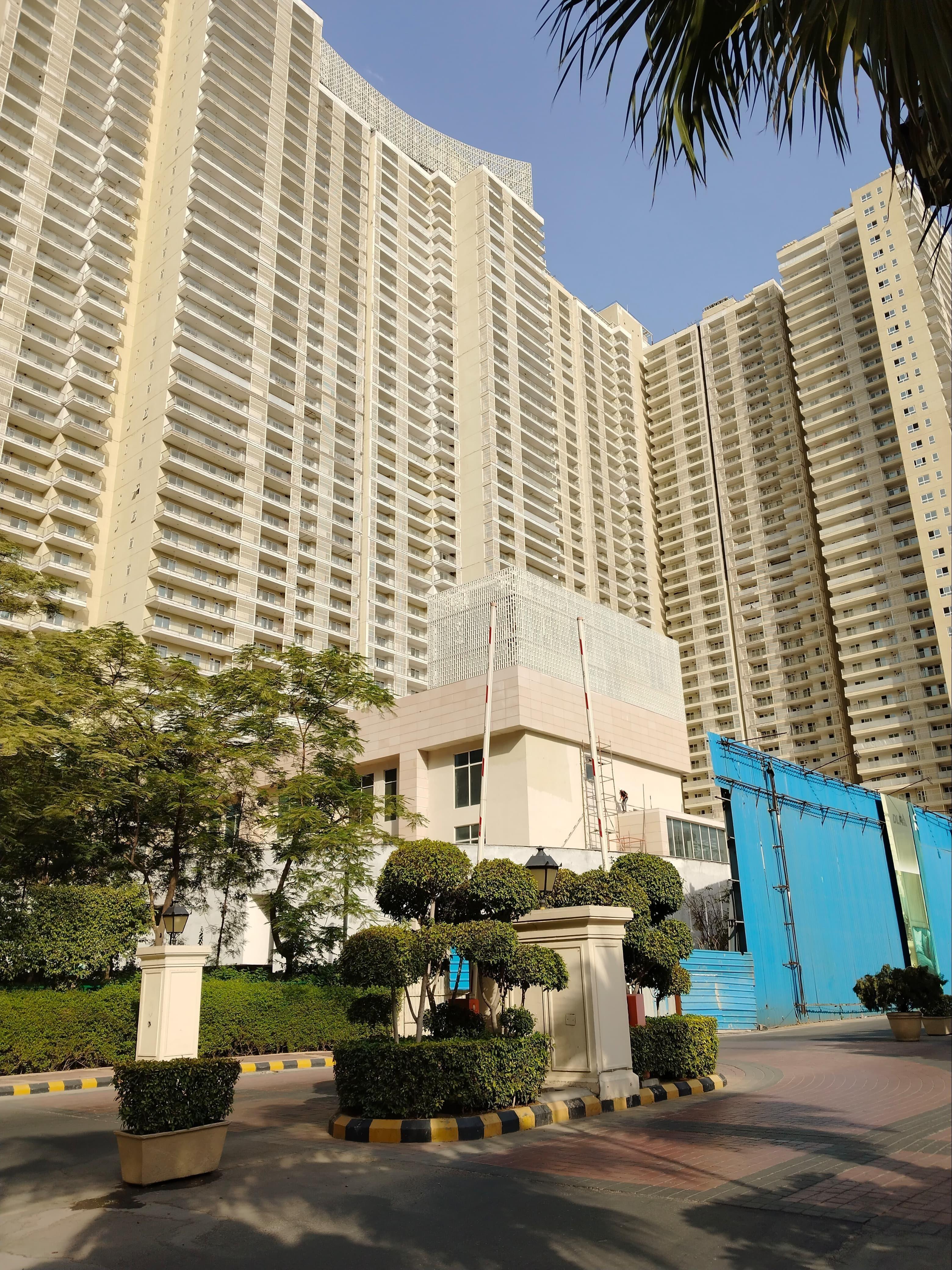





ULTRA-LUXURY REAL ESTATE ANALYSIS
A Flat Is a Depreciating Asset.
Then Why Are HNIs Paying ₹50 Crore for One?
The hidden economics of land, scarcity, privacy, replacement cost and resale value in ultra-luxury apartments.
At ₹50 crore, you are not simply buying square feet. You are buying a rare combination of location, land economics, privacy, scarcity, services and future optionality - and the difference matters.
At first glance, the question seems absurd.
A flat is a constructed asset. Concrete ages. Interiors wear out. Elevators need replacement. Towers need maintenance. So why would a sophisticated buyer commit ₹50 crore, ₹70 crore or even more to an apartment when land is usually considered the stronger long-term asset?
Because ultra-luxury real estate is not priced like an ordinary flat.
At the ₹50 crore level, the buyer is not simply purchasing square feet. The buyer may be purchasing a rare combination of land exposure, address, privacy, design, views, security, services, brand and scarcity. The apartment is the visible product. The real economic proposition is the entire property ecosystem around it.
That distinction explains why HNIs can pay enormous sums for a single residence without necessarily believing that concrete itself will become more valuable with age.
The smart question, then, is not, "Will the building depreciate?" It is: "What parts of this property can preserve or create value after the building gets older?"
1. The depreciation argument is only half the story
When people say "a flat depreciates," they usually mean the physical structure. That idea has merit. A building gets older, and some components become obsolete or require renewal.
But market value is not calculated on a simple depreciation schedule.
Real estate is a bundle of economic rights and advantages. The value of an apartment can be influenced by the underlying land, exact location, accessibility, project density, views, quality of management, scarcity, buyer demand and the cost of replacing something similar.
This is why two apartments in the same city can behave very differently over a 10 or 20-year period. One may become a tired product in an overcrowded market. Another may remain desirable because its location, land parcel, privacy and positioning are difficult to reproduce.
For HNIs, the distinction matters. They are not necessarily betting on the walls. They are often paying for everything the walls sit on, sit inside, and provide access to.
2. At ₹50 crore, price per square foot is not the whole story
A common mistake in luxury real estate is to compare only the quoted price per square foot.
Suppose two residences are both offered at a similar headline rate. One is inside a dense development on a less distinctive parcel. The other is inside a low-density project with a stronger address, larger land parcel, superior views, better privacy and a much smaller number of truly comparable units.
The second asset may justify a higher price even if the carpet-area difference is not dramatic.
Ultra-luxury buyers frequently evaluate the quality of scarcity rather than the quantity of space.
A 7,000-square-foot residence is not automatically more valuable than a 6,000-square-foot residence. The question is whether the buyer can find another 6,000 or 7,000-square-foot home with the same privacy, view, floor position, parking, service level, location and project reputation.
When substitutes are rare, the asset's economics change.
3. Land is hidden inside the apartment economics
The apartment occupies space, but it also sits on land whose economics can be significant.
This does not mean an apartment owns land in the same way a standalone plot owner does. Ownership structure, undivided share, development rights, and project documentation matter. However, the underlying land remains relevant to the economic value of a premium residential project.
Consider what happens when a city becomes more expensive and well-located land becomes harder to assemble. A luxury project built earlier on a large, strategically positioned parcel may become difficult to reproduce at today's land cost.
The buyer is therefore not purchasing only a depreciating structure. The buyer is acquiring a residence attached to a scarce piece of urban real estate.
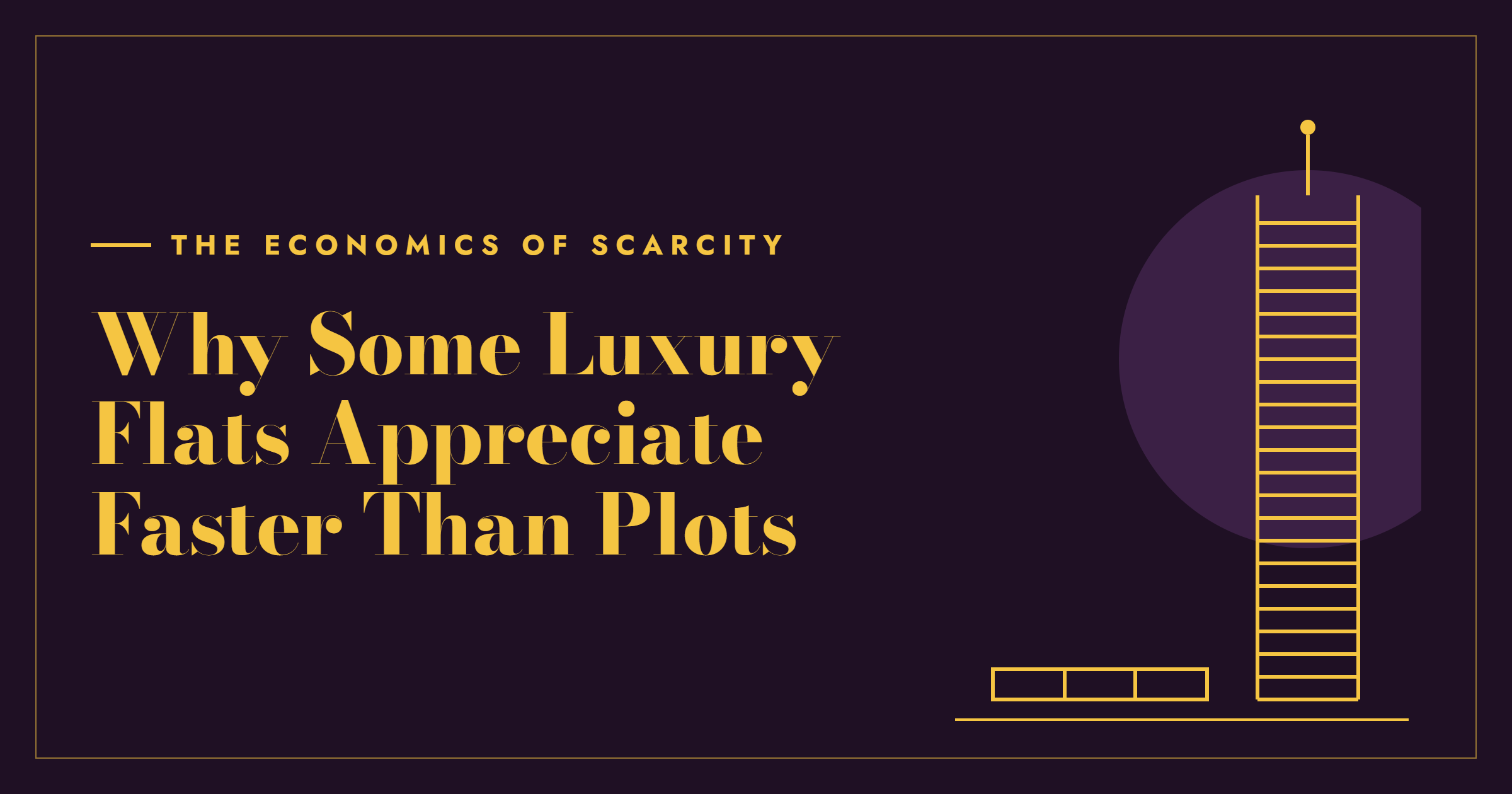
This is one reason the simplistic statement "flats depreciate; plots appreciate" can be misleading at the ultra-luxury end.
4. Scarcity is often the real asset
Luxury pricing becomes easier to understand when viewed through the lens of scarcity.
A standard apartment can have thousands of substitutes. A genuinely scarce ultra-luxury residence may have dozens, or only a handful, of realistic substitutes in the same micro-market.
Scarcity can come from a limited land parcel, a low-density layout, a particular floor plate, a signature architect, a branded residence concept, an exceptional view, a private lift arrangement, unusually large terraces or a location where new development is difficult.
When supply cannot easily expand, existing stock can stay relevant longer.
This is especially important for HNIs because a wealthy buyer is not always searching for "the cheapest large apartment." The buyer may be searching for a specific experience that only a small number of properties can deliver.
That is why two similarly sized homes can have completely different resale outcomes.
5. HNI buyers purchase optionality, not just occupancy
For many affluent buyers, the property has more than one job.
It may be a primary residence, a family base, an asset for legacy planning, a status address, a hospitality alternative, a long-term store of wealth or a future resale asset.
This creates optionality.
An ordinary investment analysis may focus heavily on rental yield. At ₹50 crore, that can be an incomplete lens because the buyer may value privacy, control, location certainty, and personal utility more than maximizing rental income.
A residence that lets a family stay in a preferred micro-market for decades can have a very different utility value than a property chosen only for yield.
That does not make the purchase automatically financially superior. It means the asset should be evaluated against the buyer's complete objective, not against rental yield alone.
6. The replacement-cost test
One of the most useful questions in ultra-luxury real estate is: "What would it cost to create this product again today?"
Imagine a project with a large land parcel, premium construction specifications, extensive amenities, low density, high-end services and a strong location. Recreating the same product may require expensive land, new approvals, longer timelines, substantial construction spending and significant marketing costs.
If replacement costs and difficulty rise while alternatives remain limited, an existing high-quality property can become economically important.
This does not guarantee appreciation. Markets can correct, projects can age, and buyer preferences can change.
But replacement economics explain why some mature luxury properties continue to command strong prices even after their original construction is no longer new.
7. Why ₹50 crore buyers think differently from mass-market buyers
The decision process changes with wealth level.
A mainstream buyer may ask: What is the rate per square foot? What is the EMI? What is the rent? How much will the price rise next year?
An HNI buying a ₹50 crore residence may ask very different questions:
How scarce is this address?
Who is likely to buy this from me later?
How many comparable residences exist?
What portion of the price is explained by land and scarcity?
How private is the building?
How strong is the developers long-term service ecosystem?
What happens if I hold for 10 years?
Can this product be replaced in the same micro-market?
Those questions are closer to private-asset underwriting than to simple home shopping.
8. The ultra-luxury resale market is a different liquidity game
One uncomfortable truth should be stated clearly: a ₹50 crore apartment can be harder to sell than a ₹5 crore apartment.
The buyer pool is smaller. The negotiation period may be longer. A seller may need to wait for a specific type of buyer rather than a general housing market.
But low transaction frequency should not be confused with zero demand.
The relevant question is: Is there a durable buyer segment for this exact product?
This is why an HNI should investigate comparable resale inventory, past transactions, realistic discounting, holding costs and the characteristics of actual buyers in the micro-market.
A trophy asset can remain valuable and still be illiquid. Both statements can be true at the same time.
9. Brand matters, but brand alone is not enough
A recognized developer, hospitality brand, fashion house or design name can influence buyer perception. In ultra-luxury real estate, branding can reduce uncertainty and add a layer of desirability.
But a famous name does not remove asset risk.
The HNI buyer should still examine location, land parcel, unit density, construction quality, maintenance model, service delivery, legal documentation, parking, access, future supply and resale competition.
Brand should be treated as one value layer, not the entire investment thesis.
The best analysis separates three things: what is genuinely scarce, what is genuinely useful, and what is simply being marketed as scarce or useful.
That separation is where due diligence becomes more important than excitement.
10. A ₹50 crore apartment can be a lifestyle asset and an investment asset
HNIs often make the mistake of forcing every property into a single category.
A residence can simultaneously be a lifestyle purchase, a wealth-preservation asset and a long-term capital allocation decision.
The challenge is to understand which role is dominant.
If the primary objective is lifestyle, the buyer should optimize for privacy, views, services, layout and family utility.
If the primary objective is capital preservation, land economics, scarcity, micro-market quality, resale depth and holding costs deserve more weight.
If the property serves both roles, the buyer should explicitly acknowledge the trade-off rather than pretending the lifestyle premium is free.
That clarity leads to better negotiation and better portfolio decisions.
11. What can make a luxury apartment lose value?
The answer is not "age" alone.
An apartment can lose relative value when the surrounding market develops better alternatives, the building becomes poorly maintained, recurring charges rise sharply, the project loses its reputation, the layout becomes outdated, views are blocked, access worsens or too many competing units enter the market.
Legal and documentation issues can also damage liquidity.
The key lesson is simple: luxury does not protect against bad asset selection.
A high purchase price can magnify mistakes because exit buyers scrutinize quality more carefully and transaction volume is lower.
12. What makes a ₹50 crore apartment resilient?
A resilient luxury apartment typically has several reinforcing strengths rather than one headline feature.
These can include a genuinely strong micro-location, difficult-to-replicate land, low-density planning, quality construction, strong privacy, good views, efficient layouts, dependable maintenance, credible documentation, a durable end-user market and limited direct competition.
Think of resilience as a stack.
If one layer weakens, the other layers can still support demand.
That is very different from buying a property because it is expensive, famous or heavily promoted.
For a high-value purchase, resilience matters more than excitement.
13. The HNI due-diligence framework
Before committing capital, a buyer should build a simple investment memo for the property.
Start with the location: What makes this micro-market valuable, and can that advantage last?
Then evaluate the land: What is the total parcel, density, development context and ownership structure?
Then examine the residence: carpet area, efficiency, floor, orientation, views, privacy, parking, storage and quality of finishes.
Then examine the project: maintenance, amenities, security, services, management and future capital expenditure.
Then examine the exit: Who is the future buyer? How many competing residences exist? What has actually traded, and at what effective price?
Finally, model the complete cost: acquisition, taxes and charges, interiors, annual maintenance, financing (if any), opportunity cost, and expected exit friction.
This is the difference between buying a luxury home and underwriting a luxury asset.
14. Five questions that can expose a bad ultra-luxury deal
1. If the brand name disappeared tomorrow, would the property still make sense?
2. If I had to sell in a weak market, who would realistically buy it?
3. How many genuinely comparable homes exist within the same micro-market?
4. What part of the price is supported by land scarcity, and what part is a design or branding premium?
5. Can another developer reproduce this product on a similar parcel at a similar total cost?
These questions are powerful because they force the buyer to separate emotion from economics.
Ultra-luxury real estate can absolutely include emotional value. The goal is not to remove emotion. The objective is to know exactly what you are paying for.
15. The FOMO trap: expensive does not mean scarce
Luxury real estate marketing often creates urgency around phrases like limited inventory, last remaining units, record pricing and signature residences.
Scarcity should be verified, not repeated.
A unit is not economically scarce merely because a sales team says so. The buyer should check the project's remaining inventory, resale stock, competing developments and future supply in the micro-market.
True scarcity shows up in the market's structure.
The strongest ₹50 crore decisions are often made when the buyer can explain the scarcity in plain language without relying on a brochure.
Conclusion: Why HNIs can rationally pay ₹50 crore for a flat
The statement "a flat depreciates" is too simple for the ultra-luxury segment.
The structure ages. That is true.
But market value can be supported by land economics, location, scarcity, privacy, views, brand, services, replacement cost and the willingness of future buyers to pay for the same combination.
So why are HNIs paying ₹50 crore for one?
Because they may not be buying a depreciating box. They may be buying access to a scarce urban asset that happens to come in apartment form.
The real discipline is not avoiding expensive apartments. It is identifying which expensive apartments have an economic reason to remain expensive.
At ₹50 crore, that distinction can be worth more than the square footage itself.
For an HNI evaluating an ultra-luxury apartment, the right starting point is not "Is the flat depreciating?" It is "What exactly am I buying, what supports its value, and who will want it after me?"
Flat vs Plot: What the HNI Is Actually Comparing
|
Factor |
Luxury Apartment |
Plot / Land |
|
Physical structure |
Aging structure plus interiors, amenities and services |
Usually much less dependent on a building component |
|
Land exposure |
Indirect / shared according to ownership structure |
Direct land ownership |
|
Scarcity |
Can be driven by address, land parcel, density, views and unit type |
Often driven by location, plot size and planning constraints |
|
Lifestyle utility |
Immediate residence with managed security and amenities |
Usually requires development and ongoing management |
|
Resale pool |
Smaller at ultra-luxury ticket sizes |
Depends heavily on land location and redevelopment potential |
|
Replacement test |
Can be strong if the same product is difficult to recreate |
Depends on whether comparable land can still be assembled |
HNI Decision Lens for a ₹50 Crore Residence
|
Question |
What to investigate |
Why it matters |
|
What supports the price? |
Land, address, scarcity, views, privacy, product quality, brand |
Separates genuine value from marketing premium |
|
Who buys next? |
End users, investors, business owners, family offices, NRI buyers |
Tests exit depth |
|
How replaceable is it? |
Competing inventory, future supply, land availability |
Measures scarcity |
|
What does it cost to own? |
Maintenance, taxes, interiors, capital expenditure, financing |
Shows total holding economics |
|
What can go wrong? |
Legal, maintenance, supply, access, reputation, layout obsolescence |
Makes downside visible before purchase |
HNI TAKEAWAY: Do not ask only whether the flat will depreciate. Ask whether the scarcity, land economics, location and buyer demand can keep the entire asset desirable after the building gets older.
Frequently Asked Questions
Is a ₹50 crore apartment really a depreciating asset?
The building itself ages, but an apartment’s market value does not move on depreciation alone. At the ultra-luxury level, buyers also pay for land share, location, scarcity, views, privacy, services, brand strength, floor position and future replacement cost. A well-selected property can therefore hold or increase value despite physical aging.
Why would an HNI choose a luxury apartment instead of a plot?
A plot gives direct land exposure, while a luxury apartment packages land participation with a finished home, security, amenities and managed services. For an HNI, the decision can depend on whether the objective is privacy, lifestyle, capital preservation, rental utility, diversification or future resale optionality rather than land ownership alone.
What makes a ₹50 crore property different from a normal flat?
A ₹50 crore property is usually evaluated as an asset and a lifestyle product, not simply by room count. Buyers may assess address quality, land scarcity, floor plate, privacy, design, parking, views, services, developer reputation, maintenance standards, resale depth and the number of comparable homes that can realistically replace it.
Do luxury apartments appreciate in value?
They can appreciate, but appreciation is not automatic. The strongest drivers are usually location quality, limited supply, improving infrastructure, brand credibility, land economics, property condition, buyer demand and scarcity of comparable homes. High ticket size can reduce the buyer pool, so resale liquidity must be evaluated alongside headline price appreciation.
Is land share important in an ultra-luxury apartment?
Yes. Land share can matter because underlying land is a major component of real estate value. In premium projects, however, investors should not look at land share in isolation. They should examine the land parcel, unit density, development potential, title structure, redevelopment possibilities and how buyers value the address.
What should an HNI check before buying a ₹50 crore apartment?
An HNI should examine title and approvals, project documents, carpet area, super area, land parcel, density, maintenance structure, parking rights, developer track record, service quality, resale transactions, holding costs and exit demand. The final price should be compared with realistic substitutes, not only with the developer’s quoted benchmark.
Why do some ultra-luxury flats sell at very high prices?
Ultra-luxury pricing can reflect a combination of scarce land, prime micro-location, large floor plates, branded design, private amenities, security, views, low-density planning and strong buyer preference. When comparable supply is limited, buyers may pay a premium for access to a specific address or product that cannot be easily replicated.
Can a luxury apartment lose value even in a premium location?
Yes. A premium location does not remove asset-specific risk. Value can be affected by poor maintenance, excessive future supply, weak project management, inconvenient layouts, high recurring costs, legal issues, changing buyer preferences or a decline in brand perception. Location is powerful, but the entire property ecosystem still determines exit value.
Is ₹50 crore better spent on one apartment or several properties?
There is no universal answer. One ultra-luxury residence can concentrate capital in a scarce, lifestyle-driven asset, while multiple properties can spread exposure across locations, ticket sizes and use cases. The appropriate structure depends on liquidity needs, concentration tolerance, cash-flow expectations, holding period and the buyer’s wider real-estate allocation.
What is the biggest mistake buyers make with ultra-luxury apartments?
The biggest mistake is treating a prestigious price tag as proof of investment quality. A luxury home can look exceptional and still have weak resale depth. HNI buyers should separate lifestyle value from financial value, verify underlying land and project economics, understand the likely exit buyer and negotiate from evidence.
PRIVATE PROPERTY ADVISORY CTA: For an HNI evaluating a ₹10 crore, ₹25 crore, ₹50 crore or ₹100 crore+ residence, the highest-value conversation is often not about finding more inventory. It is about identifying which few properties have a defensible reason to remain desirable at exit.